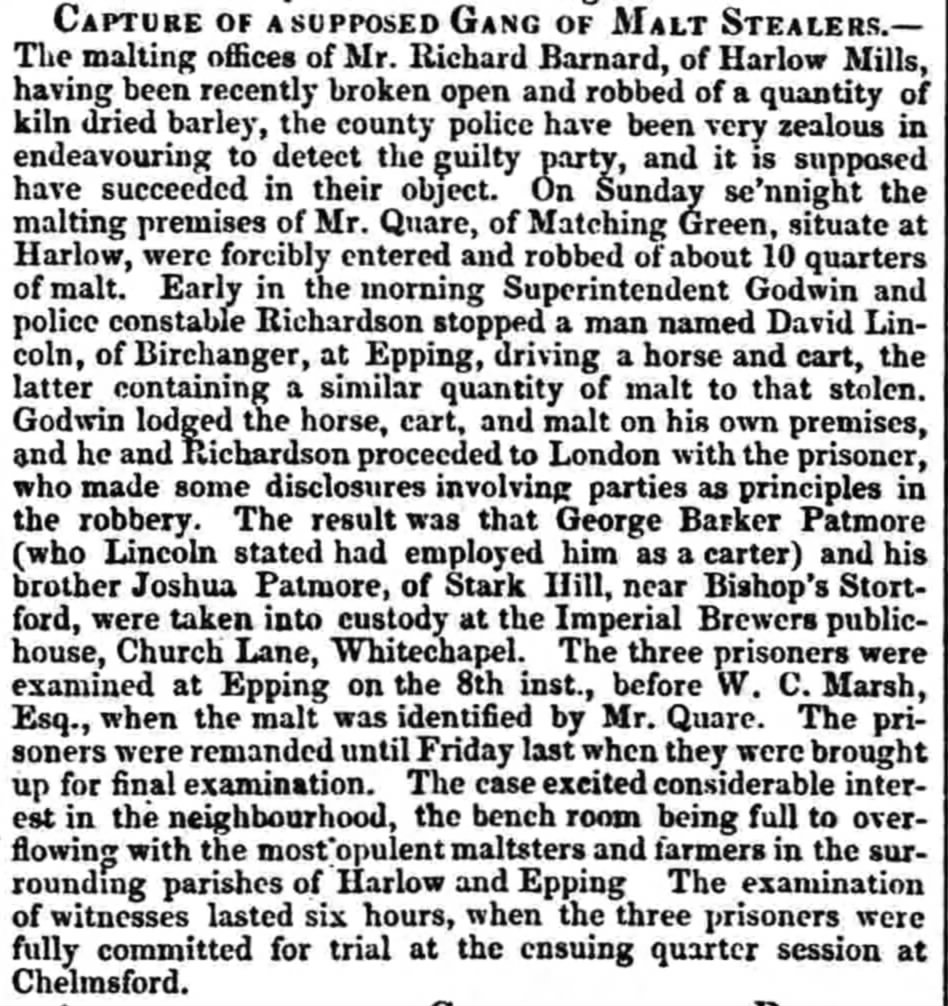
This is the Court Transcript from The Chelmsford Chronicle 21Oct 1842:-
Wholesale Malt-Stealing at Harlow – (At the Colonies Assizes Court at Hamilton, Bermuda)
Joshua Patmore, 18, jobber, and David Lincoln, 56, labourer, were indicted for breaking into the malt shop in the occupation of Thomas Hewitt Quare, at Harlow, and stealing seventy-six bushels and three quarters of a peck of malt, belonging to him and to Tudor Brain Quare, and George Barker Patmore, 21, jobber was indicted as being an accessory before the fact.
Mr. Marsh and Mr Pryor were counsel for the prosecution and Mr Know and Mr Rodwell for the defence. Mr Marsh, in stating the case, observed that it was one of considerable importance, and the result was looked to by maltsters with great interest, as they were a class of persons who were particularly liable to depredations of this sort, which they rarely enabled to detect. The Patmores were brothers, living at Birchanger, and were small farmers, and Lincoln was in their service. The learned counsel then entered into further details, and called the following witness:-
Tudor Brain Quare, examined. I live with my brother Henry Thomas Hewitt Quare, maltster and farmer; I act for him in the malting business, which is carried on at Matching Green and Sawbridgeworth, and have a share in the business; there is also a malting at Harlow which my brother hires of Mr Harnard; there are several maltings by the side of it; ours is No. 6; the plan of the premises produced is accurately laid down; on the 7th August my brother had more than 300 qrs of unscreened brown malt at No 6; it was made by John Shipton, my servant, and was carted by John Burr; on Monday the 8th August I was informed that the malting was broken open; I missed about 10 quarters. Cross-examined by Mr Knox. I receive a share of the malt business; I had not noticed the particular quantity in the warehouse for some time before.
John Burr. I cart malt for prosecutor. The latter end of Jan. and Feb. I carted about 300 quarters of unscreened brown malt at the shop of Harlow; on the 10th August there was not the same quantity as I had carted; I had not carted any away in the meantime.
Seth Salmon, in prosecutor’s employ. On Monday morning, the 8th August I passed Mr Quare’s malting at Harlow and saw the track of a cart about 3 yards from it; I observed it both to and from the shop yard; the track was not visible the previous evening. Cross-examined. I looked for the tracks by my master’s orders for several days.
John Branch. I am employed by Mr Richard Barnard to watch the malt shops at Harlow; five
belong to my master and No 6 to Mr Quare; on Sunday evening the 7th August, I saw that all the malt shops were safe outside; there were no tracks of wheels on the ground at that time; about half past five the following morning I found my master there with John Palmer, his foreman, and saw that the upper door of Mr Quare’s malting was broken open; it was fastened by a padlock the hasp of which had been pried open. I observed the track of wheels both to and from the yard; 4 bushels of malt are generally put into a sack when sent out.
Mr R Barnard. On Monday the 8th of August, my foreman informed me that Mr Quare’s malting had been broken open, and on going there we saw the track of the cart, which appeared to have been backed down the yard; I sent for a policeman, and on our going into the malting office, I saw that the malt had been disturbed; I had not sent a cart to the premises for two to three weeks.
William Richardson, police constable. I was sent for to Mr Barnard’s on the 8th August. I saw some malt on the ground, and in the malting I could clearly see that malt had been disturbed; I saw the mark of two wheels of a small cart of the width of three inches, near No 6 shop; a few yards from the spot, near the track, was the mark of the footing of a horse, one of the impressions being that of a half shoe, and another being peculiar. I traced the wheels two miles towards Epping, and on reaching that place at half past seven, I saw a cart going up the road heavily laden with sacks; Lincoln was driving it; I asked him what his load was, he did not know; I asked if the load was not malt, and he replied that he believed it was; I then took him into custody, when he told me his master, George Barker Patmore (whose name was on the cart) had sent him with the cart from Start Hill, Birchanger, and told him to go on the London Road, and he would meet Joshua; that he did so and he met Joshua at the corner of Redrick Laine; that he stopped there a few moments after having given the cart up to Joshua; that Joshua went on with the cart towards Harlow, and he followed on the road till he got near the railway bridge, when he heard the cart coming, that Joshua was driving, and it was loaded as he (the policeman) found it; that Joshua told him to drive it to London, which he was doing when he was stopped, and that he did not know where the malt came from; he also said that he should meet his masters in London; I took the horse and cart to Epping, and on measuring the wheels they exactly corresponded with the impressions near the malting; a new shoe was on the horse, and on enquiry at Epping, I found that the horse had been shod; the nails on another shoe corresponded with the marks about the malting; I then went to London accompanied by superintendent Godwin and Lincoln;
We reached London at about 1; at 3, the time Lincoln said he was to meet his masters, we went to a beer shop in Whitechapel, where Lincoln pointed out the two Patmores, who were drinking; Lincoln told them that he had got into trouble about the malt; George said he could not get into any trouble, as the horse and cart and malt were his; Joshua said that he knew nothing about it; on returning to Epping I examined the malt and took samples, which I produce.
Aaron Barltrop, blacksmith of Epping, proved putting a shoe on a horse brought by Lincoln on the morning of the 8th August, between seven and eight o’clock.
Superintendent Thomas Godwin, proved receiving the cart horse and malt of Richardson. The quantity of malt was nine quarters, four bushels, and three pecks, and it was contained in 17 sacks. He then corroborated Richardson’s testimony; and added that on the 9th August he found in the bottom of the cart half a horse shoe.
Frederick John Copland, policemen, proved the exact quantities of malt in the 17 sacks, each sack contained more than four bushels.
Frederick John Copland, policemen, proved the exact quantities of malt in the 17 sacks, each sack contained more than four bushels.
John Shipton, Mr Quare’s maltster. I make my master’s malt at Matching Green. I compared a sample of the malt taken from the bulk at Harlow with a sample found in the cart, and they exactly corresponded. I believe both samples to have been made by me; it was thin barley and had red ends.
James Foster. I keep a beer-shop near Harlow mill. On Sunday afternoon the 7th August, soon after three o’clock I saw Joshua Patmore opposite my door which is about 400 yards from Mr Quare’s malting; he inquired of me if I could recommend him to a ready furnished room; I have him what directions I could and he went away.
Elizabeth Barnes I live at Thremhall turnpike gate, between Stortford and Dunmow. The Patmores live on a farm at Start Hill Birchanger about half a mile from my gate; on Sunday afternoon about half past six Joshua Patmore and David Lincoln passed through Thremhall gate in a cart, in the direction from their own house.
Rowland Mardell I keep a beer shop at Hallingbury. On the evening of the 7th August about 11 o’clock Lincoln had a oint of beer at my house; he was in a horse and cart alone; Hallinbury is on the direct road to Harlow from Start Hill; the horse and cart taken by the policeman belong to George Patmore.
Willian Campbell, policeman My beat is near Start hill. About 11 o’clock on Sunday night the 7th August I saw Patmore’s sister near his house; I spoke to her and whilst in conversation a man came out of the yard driving a cart, which was empty; the man slightly turned his head as he passed. I afterwards saw Lincoln in Ilford gaol and from his size and dress I believe him to be the person who was in the cart; the horse and cart take by Richardson were similar to those I saw leave Patmore’s yard.
William Gant, porter to the Northern and Eastern Counties Railway at Harlow. On Monday morning August 9th between 7 and 8 o’clock Joshua Patmore took a ticket for a second class carriage to go to London; he looked quite fatigued as if he had been up all night and his shoes were very dirty; there is a station at Hockerill near Stortford.
The case for the prosecution having closed Mr Knox addressed the jury at great length on behalf of the prisoners, urging the slight nature of evidence against them, without that afforded by Lincoln, which by law was inadmissible, except against himself.
Two witnesses were then called, John Linsell, farmer at Birchanger and William Smith both of whom had known the Patmores many years and had never known anything against them before this transaction.
On 18th October 1842 Joshua, George and Lincoln were convicted of House breaking and sentenced to 10 Years Transportation . They were taken to the ‘Leviathan’ Prison Hulk moored at Portsmouth.
The Prison Hulks were old naval vessels that were anchored to the seabed to house the large number of prisoners who were overcrowding prisons after the government bought in harsher laws to try to combat petty crime. Each would hold 150 – 200 prisoners but as more people were convicted the numbers increased to 300 or more. The convicts would eat mouldy meals, wear rotten unwashed clothing, and would sleep on the floor. Disease and death were common. In 1787 the British Parliament decide to start sending ships full of convicts to Australia. The First Fleet consisted of eleven ships that held nearly 1500 people. Many other ships followed.
The Prison Hulk Register shows that George Barker Patmore was reported by his Gaoler on 9th June 1843 as being “Reputable”. He was transferred to Stirling Castle on 31st October 1844.
On 8th October 1846 Joshua departed on the ‘Pestonjee Bomanjee’ for Van Diemen’s Land, arriving on 17th February 1847.
He received his Ticket of Leave on 18th December 1852 and a Conditional Pardon on 24th December 1853. He married Maria Gangell (1832 – 1912) on the 1st February 1853 in Swanport.
In the Chelsford Chronicle on 18th May 1855 was a story of The Takeley and Navestock Burglaries. It says that “for some time past it has been surmised that an organized band of burglars have been prosecuting their nocturnal depredations in a most systematic manner in the Ongar division and no little excitement has been occasioned by the apparent impunity with which the fellows have continued their nefarious operations.” George Barker Patmore was a suspect. He was apprehended in London and gave various and conflicting statements as to his place of residence and what he had been doing of late. The officer said, however, that he could not swear to him being one of the gang and George was remanded.
On 18th September 1855 Joshua Patmore (Senior), his wife Ann and George (35), Priscilla (20), Thomas (17) and Richard (15) left England on the Indian Queen to follow Joshua (Junior) to Tasmania. George died at sea on 29th November. The rest of the family arrived in Hobart on January 22nd 1856 but their daughter Susannah Ann (1829 – ? ) remained in England. Their son Aaron Swithin had passed away in 1854 at the age of 23.
 ironpotbrewing.com.au